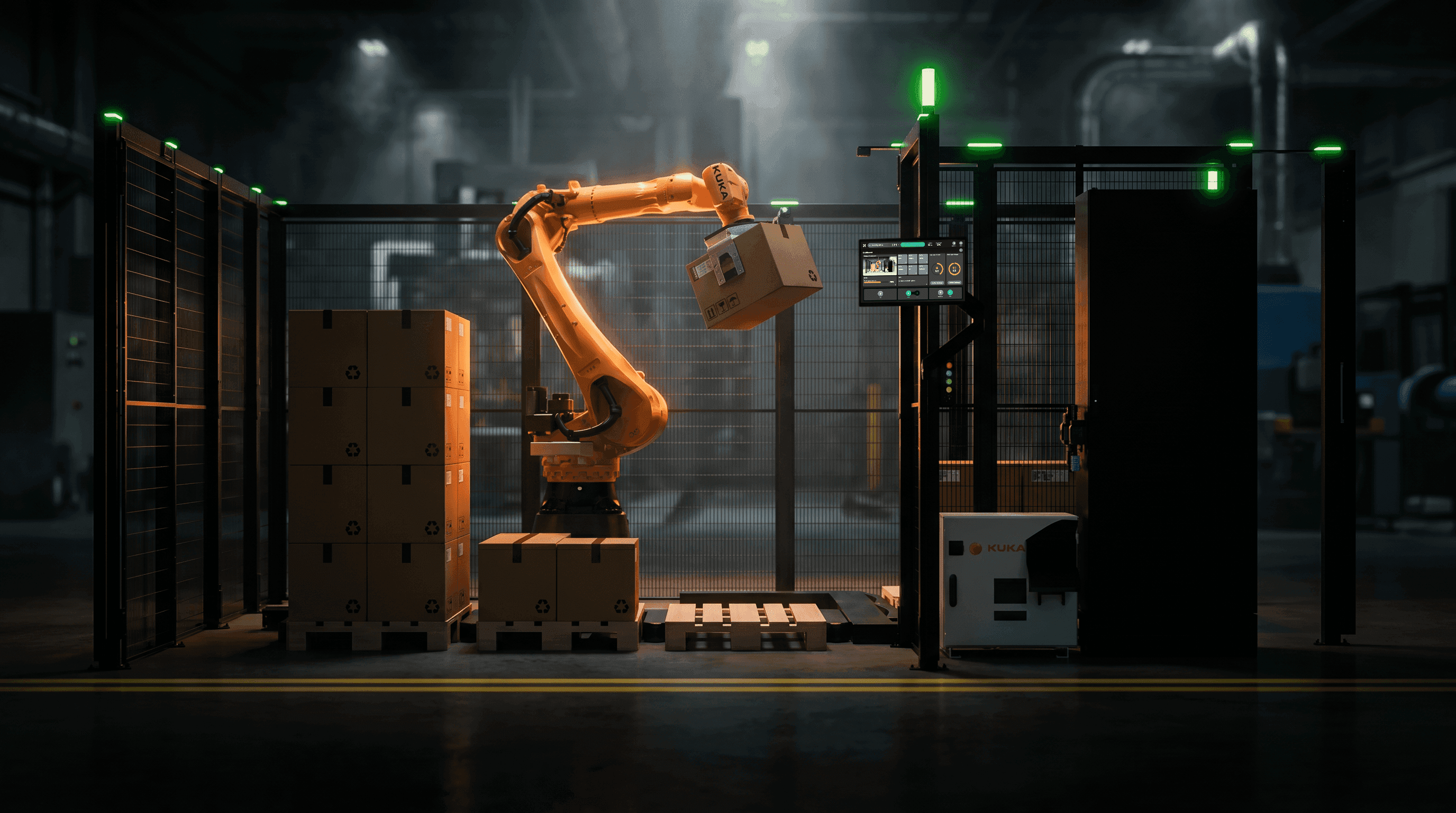
Gestalt cannot become obsolete because it describes the viewer, not the screen. Which is why it is now dangerous: it will confidently group a guess with a fact.
Four numbers, one of them invented
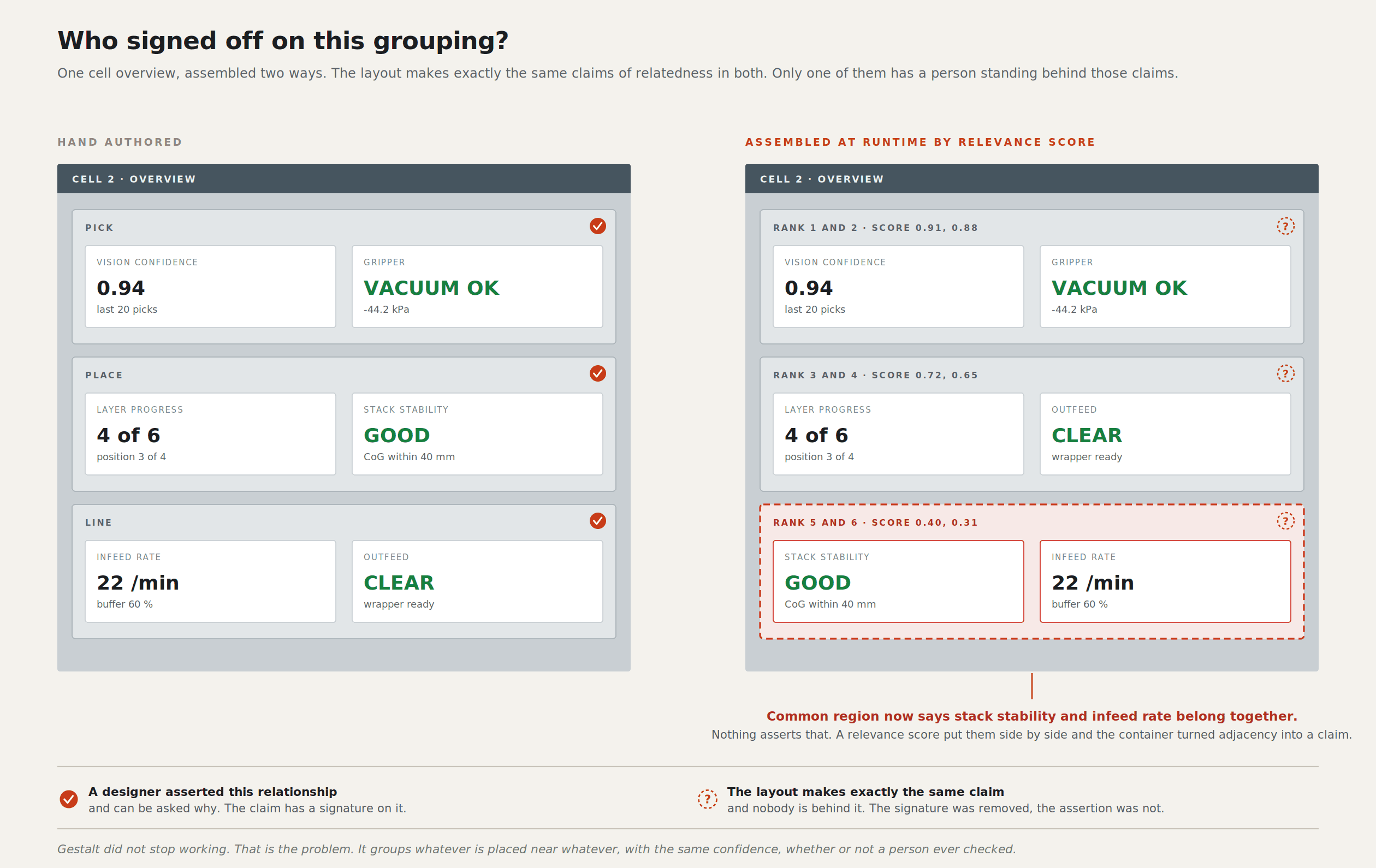
On a cell overview I worked on, the incoming case panel carried four values. Width, depth, height, weight. Same type size, same weight of type, same grey, same column, stacked in a tidy block with four points of leading between them.
Three of those numbers came off a 3D scanner. The fourth did not. Weight was not measured anywhere in that cell. It came from a catalogue entry the system had matched by dimensions and label, falling back to the nearest neighbour by volume when the match was poor.
An operator spent most of a shift working out why one SKU kept producing a layer that leaned. He reasoned from the weight, because why wouldn't you? He concluded the stability solver was wrong and started overriding placement order by hand. The weight was off by about a kilo and a half.
Nobody misread a label. The labels were correct, present and legible. The layout made the claim. Four numbers in one block, in one treatment, assert that they are four instances of the same kind of thing. Three were readings. One was an opinion. Proximity and similarity fused them into a single object called "the case data", and the operator's visual system did that before he got anywhere near the word "weight".
That is the article. The rest is why it happened and what you do about it.
It was never a set of layout rules.
Worth being accurate about what Gestalt claimed, because the design industry inherited it as a style guide, and that is not what it is.
Max Wertheimer published "Untersuchungen zur Lehre von der Gestalt II" in 1923, usually cited in English as "Laws of Organisation in Perceptual Forms" (Classics in the History of Psychology). The Berlin school around him was not writing design advice. They were making an empirical claim about how the visual system resolves an ambiguous field of stimulation into discrete objects, according to regularities you can demonstrate in anybody.
The best modern status check is the two-part review Johan Wagemans and colleagues published in Psychological Bulletin in 2012 to mark the century, covering grouping and figure-ground organisation in Part I (138(6), 1172-1217) and the theoretical foundations in Part II (138(6), 1218-1252). A century of attempts to dismantle the thing, and it is still standing, with better mechanistic accounts underneath it than Wertheimer had.
Two details from that review matter here. The principles are descriptive before they are prescriptive: proximity is not a recommendation; it is a statement about what will happen to a viewer whether or not you intended it. That is the part designers forget when they call a principle outdated.
And the canonical list grew. Wertheimer's set was proximity, similarity, common fate, good continuation, closure, symmetry and parallelism. Synchrony, common region, element connectedness and uniform connectedness were added well after the Berlin school (Wagemans et al., Part I). The late additions turn out to be the ones an adaptive machine needs most, which is not a coincidence.
Grouping is an assertion, and it used to have a signature on it.
The shift that actually happened has nothing to do with whether the principles still hold.
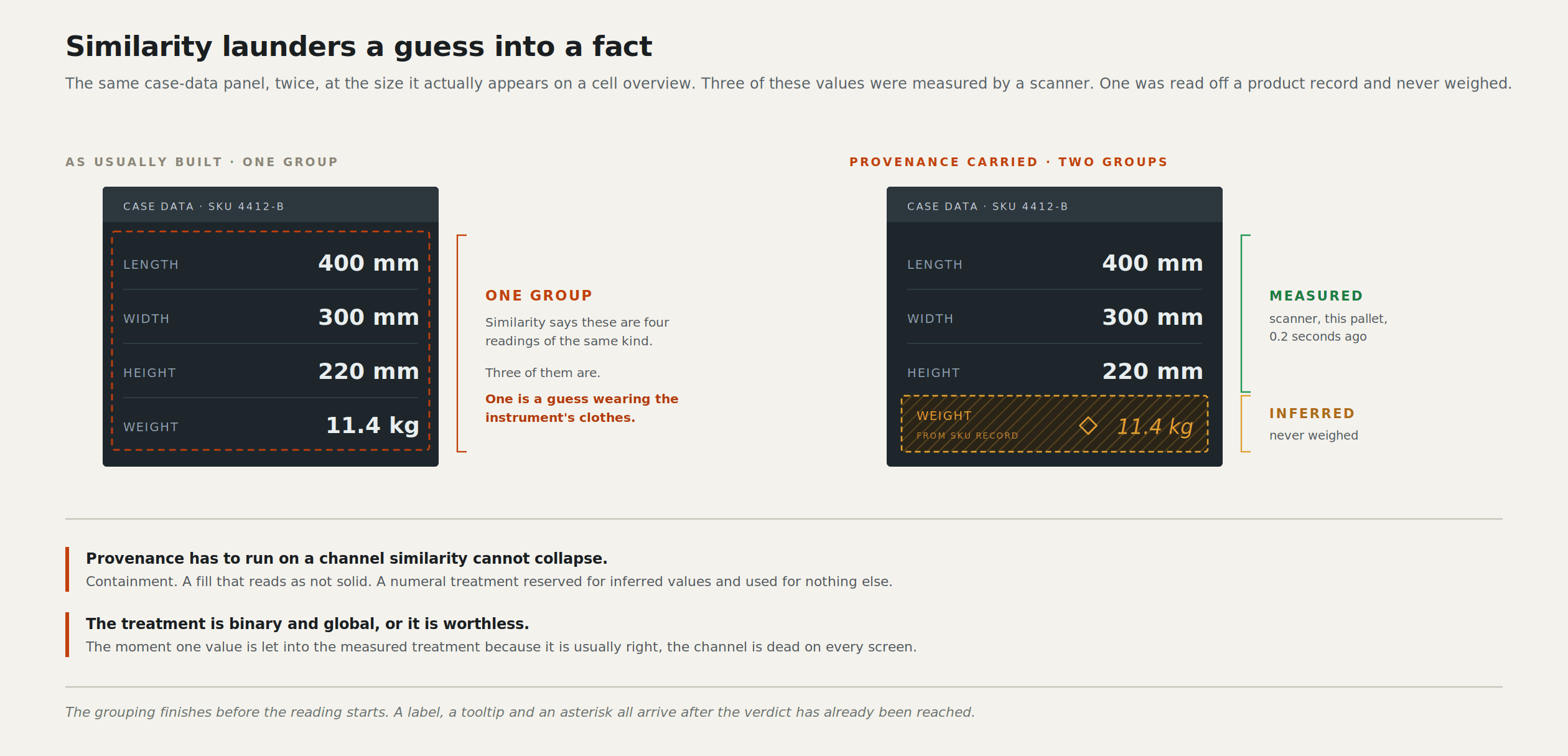
Every act of grouping is a factual claim about the world. Put two elements close together, and you have asserted they belong to one another. Give them the same colour, and you have asserted they are the same category of thing. Draw a box around five controls, and you have asserted that those five and only those five act on one subject. These are not aesthetic gestures. They are propositions, rendered in a channel processed faster than language.
For the whole history of the discipline, a person guaranteed each proposition personally. I drew the panel. I decided those four numbers went in one block. If the grouping was wrong, it was wrong because I was wrong, and the error sat in a file with my name on it.
That guarantee is what has gone. Not the grouping. The guarantee.
A modern industrial screen is assembled at runtime. Cards ordered by a relevance score. A list sorted by an anomaly ranking. A panel populated by whatever fields the connected device exposes. An agent picking a component because the name matched a field name. A whole layout produced by a generative tool in an afternoon, and I have written elsewhere about how good that tooling has got (AI platforms for building HMI visual interactions).
Each of those mechanisms places things next to other things, and each placement makes the same assertion it always made. What has changed is that the assertion is now a side effect of a sort order, and no human being has checked whether it is true.
Nobody removed the claim of relatedness from the layout. They removed the person who was standing behind it.
Which is why the "is Gestalt obsolete" question is upside down. Gestalt has become more consequential, not less: the volume of unverified visual assertions per screen has gone up by an order of magnitude, and the machinery that converts them into belief is unchanged and free.
Similarity launders a guess into a fact.
Of the classical principles, similarity will do the most damage in an AI-era interface.
Similarity says elements sharing a visual attribute are read as members of one class. On an industrial screen, the most load-bearing class is "instrument reading". Operators have learned, mostly without anyone teaching them, that a numeral in a particular position, at a particular size, in the readout treatment, is a thing the machine measured. That convention is decades old and very strong.
When a system-generated estimate is rendered in that same treatment, similarity does not merely fail to distinguish it. It transfers the instrument's credibility to the inference. The guess inherits the sensor's authority. That is laundering, and the layout is the launderer.
Timing is what makes it unfixable downstream. Grouping by a basic visual feature happens preattentively, before focused attention arrives to do anything careful, which is the core of Treisman's feature integration work and survives into current models of visual search such as Wolfe's Guided Search 6.0 (Psychonomic Bulletin & Review). Call it a fifth of a second if you want a number, but I am not citing one, because the honest literature does not hand out a single figure. The structural point is enough: the grouping finishes before the reading starts. An asterisk, a tooltip and a lighter grey caption all arrive after the verdict.
The design answer has to run on a channel that similarity cannot collapse, and it has to be legible without fixation.
What works, on the cells I have designed for. Containment, which I cover below. A shape difference, because shape is preattentive and survives distance and glare. A fill or texture that reads as "not solid", used for this and nothing else. A dedicated numeral treatment for inferred values, defined once in the philosophy document and unavailable to any designer for any other purpose.
What does not work. A label. A tooltip. An asterisk. A different shade of the same grey, which is a similarity gradient and therefore reads as "same class, slightly different", the opposite of what you need. And a confidence percentage beside the number, which I have argued against at length because it manufactures the over-trust it claims to prevent (Show the Runners-Up).
One rule I hold without exception: provenance treatment is binary and global. The moment a system lets a value appear in the measured treatment "because it is usually right", the channel is dead everywhere. A channel carries meaning only while it is exceptionless.
The principles that arrived late are the ones you need now.
Synchrony and common fate are the two principles I use most, and I almost never see them used in industrial software. The reason is structural: they require motion, and a screen mirroring a deterministic machine has very little motion worth grouping.
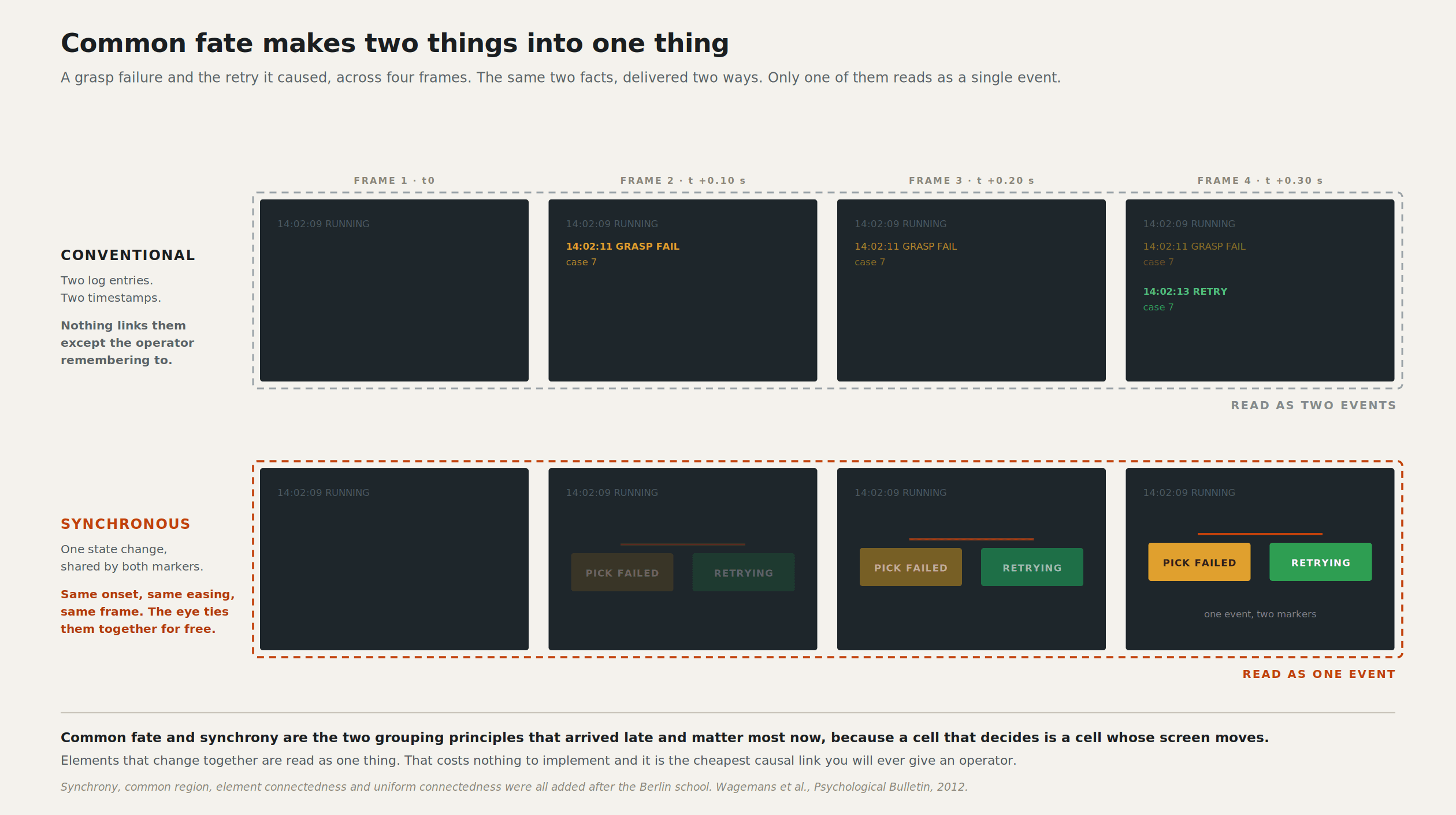
Common fate says elements that move together are read as one thing. Synchrony says elements that change at the same moment are read as one thing, even without shared direction. Synchrony was not in Wertheimer's set at all (Wagemans et al., Part I).
A cell that decides has motion in it by definition. It re-plans, it reorders, it retries. Those are the events an operator most needs to understand, and they are events in time, which is exactly the material common fate and synchrony work on.
Ghost the plan as one object. When the solver has committed to the next three placements, I render all three at once in a reduced treatment and animate them in together and out together. Sharing a fate, they read as one plan. Show them appearing one at a time as each becomes current and they read as three separate facts, which is a lie: the third is contingent on the first two, and when the cell deviates, the operator needs to have understood that a plan was what they were looking at. This is projection support in Endsley's sense, and projection is the level industrial screens serve worst (Endsley 1995).
Bind a retry to its cause. A grasp fails and the cell retries with a different approach. Rendered conventionally, you get two log lines, and the operator has to infer causality from adjacency in a list, which is proximity doing work it is not qualified for. Rendered with synchrony, the failure marker and the retry marker change state in the same frame with the same easing, and the eye receives them as one event with two parts. Mixed-case palletising is full of these paired events, because re-planning on out-of-sequence arrival is normal operation (AI in palletising).
What makes this work is restraint. If three unrelated things animate on the same tick because that is when the poll returned, synchrony has asserted a relationship that does not exist. Shared timing is a claim. Never let a refresh cycle decide what moves together.
Containment is the only lever you have over a layout you did not author.
If a relevance ranking has put a measured throughput figure next to a predicted one, you have lost control of proximity. You cannot fix that by moving things, because you are not the one moving things.
You can still control containment, and containment outranks proximity. That is the practical core of common region. Nielsen Norman Group puts it about as plainly as it can be put: "Creating a clear boundary is a strong visual cue that can overpower other grouping principles such as proximity or similarity", and "items within a boundary are perceived as a group and assumed to share some common characteristic or functionality" (NN/g).
Uniform connectedness is the stronger cousin. Palmer and Rock argued that a connected, uniformly coloured region is a more fundamental unit of organisation than the classical grouping factors, and that grouping operates on those regions rather than raw elements (Psychonomic Bulletin & Review). A shared background is not decoration behind the content. It decides where the content divides.
This gives the practical rule for generated layout. You cannot guarantee adjacency, so stop trying. Guarantee boundaries instead. Define regions by what they are epistemically, not by what they are about. Measured state here. Inferred state here. Operator input here. Then let the sort order do what it likes inside a region, because there the assertion of relatedness is one you authored.
This is why I will defend containers in industrial UI against every minimalist argument I have heard. Borderless cards and edge-to-edge grids are a genuine achievement in consumer software, where a false grouping means somebody taps the wrong thing. On a cell where a false grouping means a guess was read as a measurement, a boundary is a cheap safety artefact. It costs four pixels of gutter and buys the only grouping cue that survives a layout you did not write.
On a screen carrying generated content, the absence of a boundary is itself a claim, and usually false. Whitespace asserts separation only when somebody chose it. When flexbox does it, proximity fills the vacuum.
The Prägnanz trap
This is the part of Gestalt I think is genuinely hazardous in an AI interface, and I haven't seen it discussed as a hazard anywhere.
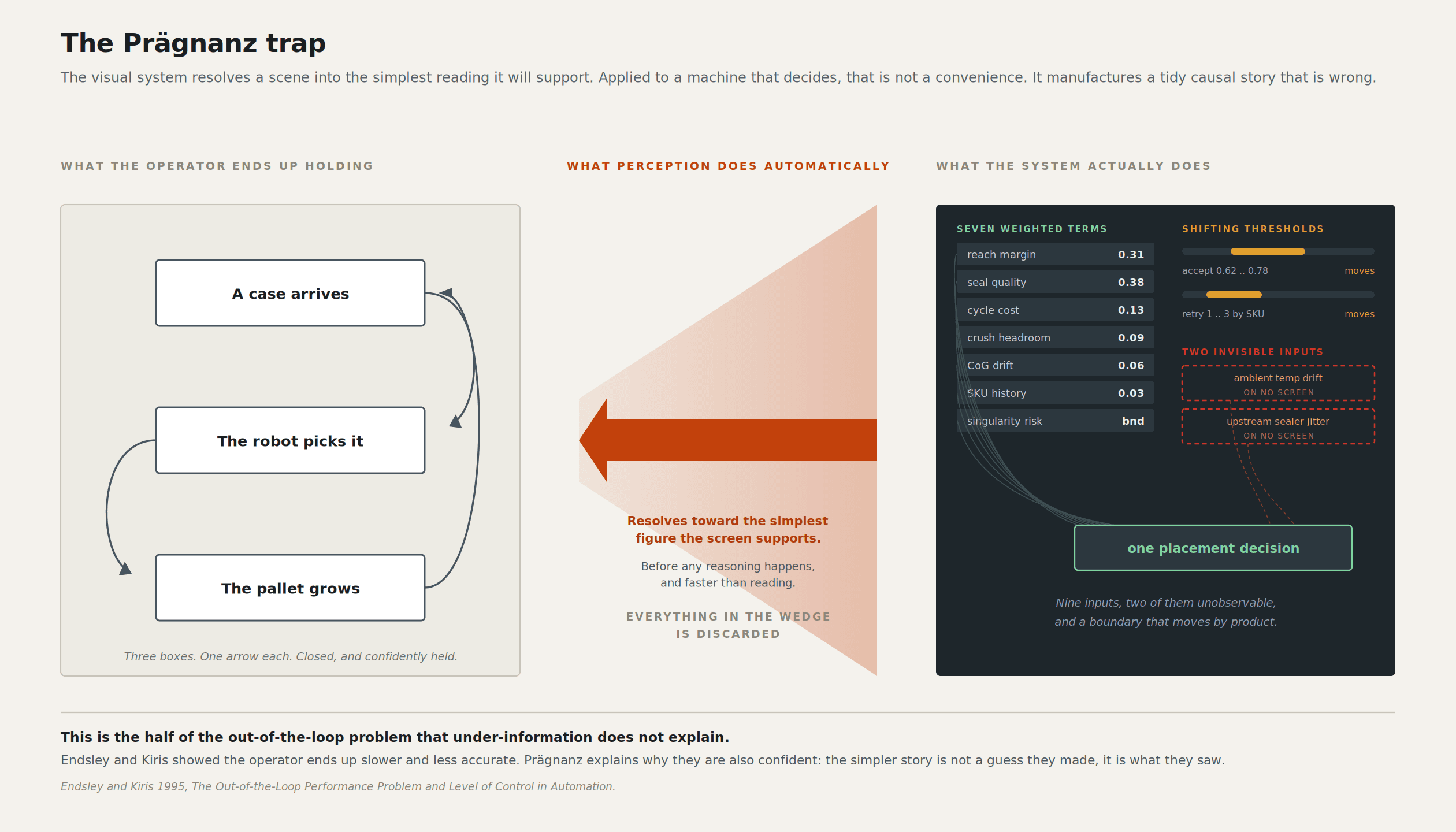
Prägnanz, the law of good form, says the visual system resolves any scene into the simplest, most regular, most stable interpretation the evidence will support. It sits underneath all the other principles, and Wagemans and colleagues spend much of Part II on how hard it has been to formalise and how stubbornly it keeps being right (Psychological Bulletin, Part II).
Now apply it to a machine whose behaviour is probabilistic.
The operator is not only organising shapes. They are constructing a causal account of what the machine is doing from the evidence the screen provides, and Prägnanz predicts they will build the simplest account that evidence supports. Not the truest. The simplest one consistent with what is on the screen.
The true account of a learned policy or a weighted multi-objective solver is not simple. It is a ranked set of trade-offs shifting with inputs nobody on the floor can see. A tidy screen supports a tidy story, and the visual system manufactures that story quickly, completely, and with the full subjective confidence of a perception rather than the tentativeness of a hypothesis. It does not feel like a guess. It feels like seeing.
That is how you get folk theories that sound like observations. It prefers the back row. It struggles with the shiny cases. It gets confused when the conveyor is full. Each is a well-formed, economical, stable interpretation of a screen that lacked the structure to support a more complicated one. The screen did not cause the theory by being wrong. It caused the theory by being tidy.
Set that next to the out-of-the-loop performance problem, and the mechanism gets uncomfortable. Endsley and Kiris showed thirty years ago that higher automation degrades operator awareness, so when intervention is finally required, they perform worse than if they had controlled the process manually throughout (Human Factors, 1995). Endsley returned to the shape of these failures in 2024 (Journal of Cognitive Engineering and Decision Making).
The usual reading is that the operator ends up under-informed. Prägnanz supplies the second half: they end up under-informed and confident, and the confidence comes from their own perceptual system working correctly on an impoverished display. Under-information alone produces hesitation, which is recoverable. Under-information plus a clean, closed, well-formed mental model produces decisive wrong action, which is not recoverable.
So Gestalt is not only a tool here. In this failure, it is part of the error mechanism, and a designer who thinks of it only as a tool will optimise straight into the trap by making the screen ever cleaner.
The counter-move feels wrong the first few times. Leave visible evidence of the complexity the simple story cannot absorb. The margin between the chosen option and the runner-up. Ghosted alternatives that did not win. A provenance treatment that refuses to let an inference look settled. None of that is clutter. It is structure that stops the interpretation from closing prematurely, and a screen with no loose ends will be understood wrongly and fast.
Where it runs out
The honest half of the answer. Gestalt is necessary, but not sufficient, and the gap is not small.
No principle for provenance. No classical or later principle distinguishes an element by where it came from. They organise by spatial and temporal relations among elements all assumed to be equally real. A hundred years ago, nothing on a display had a source worth interrogating, because a display was an instrument face. Provenance is now the central epistemic fact of an industrial screen, and Gestalt is silent on it. I press similarity, common region, and uniform connectedness into service, but I borrow tools built for another job.
No principle for confidence. Grouping is categorical. Things are in a group, or they are not, and perceptual organisation has no native representation for "this belongs to the measured class with probability 0.6". A screen fed by models is full of values whose class membership is genuinely graded, and the perceptual system rounds every one to certain. Any graded treatment you invent, opacity ramps, hatching densities, softened edges, is a convention taught from scratch rather than a principle relied on.
Time handled weakly. Common fate and synchrony are the only real temporal principles, and both concern simultaneity, a thin slice of time. HMI needs sequence, causality, duration, latency and pending state, because the operator's question is almost always "what happened, in what order, and what caused what". Gestalt offers nothing for causality across a four-second gap, and four seconds is where most misunderstanding in a robot cell lives.
What fills those gaps is not Gestalt, and I do not pretend otherwise. ISA-101's lifecycle discipline, particularly the requirement to write an HMI philosophy document before drawing anything, is where a provenance convention gets defined once and enforced globally (ISA). I test a screen against Endsley's three levels, because "is it clearer" isn't testable and "does it support projection" is. Splitting one system into engineering, configuration, and operator interfaces is how the same truth shows up at three depths without one screen carrying it all (The HMI Was a Mirror).
The two traditions already meet in one place without anyone saying so. Holding a whole screen at low saturation so colour means something when it appears is a Gestalt strategy in everything but name: similarity and figure-ground managed as a scarce resource. Nobody calls it that, and it works anyway.
The verdict, with numbers
I was asked to rate it, so here are the numbers.
Value of Gestalt to modern HMI: 9 out of 10. Higher than in the deterministic era, not lower. It loses a point for the three gaps above, which are real and which no amount of clever application will close.
The role has inverted, though, so the rating means something different. Gestalt used to be a composition tool, a set of moves a designer made to build a coherent screen from nothing. It is now primarily a constraint on generated layout, a specification you hold a runtime assembly process to. The question has changed from "how do I group these elements" to "what will this system assert when it lays this out, and is the assertion true?" That is closer to writing an acceptance test than composing a page, and it calls for a different deliverable: rules about what may and may not share a region, a treatment, or a moment, handed to whoever is building the layout engine.
Industry application of Gestalt in industrial HMI: 3 out of 10, generously. What gets applied is the decorative reading: consistent card padding, an eight-point grid, tidy alignment, proximity used to make a screen look organised. That is the tenth of the subject that survived being turned into a slide deck. The principles carrying real weight in an adaptive system, common region as a provenance boundary, common fate as the marker of one plan, synchrony as an assertion of causality, and similarity treated as a hazard rather than a tool, are close to unused. I have opened a lot of vendor screens in five years and can count on one hand the ones where a generated value was structurally distinguishable from a measured one at a glance.
The broader version of this I have written about separately: what an AI-assisted process degrades first is not correctness but discrimination, the ability to see that two things which look alike are not the same thing (Taste is the last differentiator).
So the answer is no. Gestalt has not been made irrelevant by AI, and the people saying so have confused the artefact with the perceiver. The visual system is not a legacy technology awaiting deprecation. It is the one component in the stack guaranteed to be still running in fifty years, exactly as it runs today, grouping whatever you put in front of it.
It will group a sensor reading with a probability estimate and hand the operator a single confident object, before anybody has read a word. The layout made that claim. Somebody has to be accountable for it, and on most screens nobody is.
Sources
Wertheimer, Laws of Organization in Perceptual Forms (1923), Classics in the History of Psychology
Harley, The Principle of Common Region: Containers Create Groupings, Nielsen Norman Group (2020)
Wolfe, Guided Search 6.0: An updated model of visual search, Psychonomic Bulletin & Review (2021)
Endsley, Toward a Theory of Situation Awareness in Dynamic Systems, Human Factors (1995)
ISA-101 Human Machine Interfaces for Process Automation Systems, International Society of Automation
Leon Potgieter designs HMI and visual systems for industrial robotics. He has spent the last five years as the visual systems designer for Unchained Robotics in Germany, working on the operator, configuration and engineering interfaces behind the MalocherBot cell.