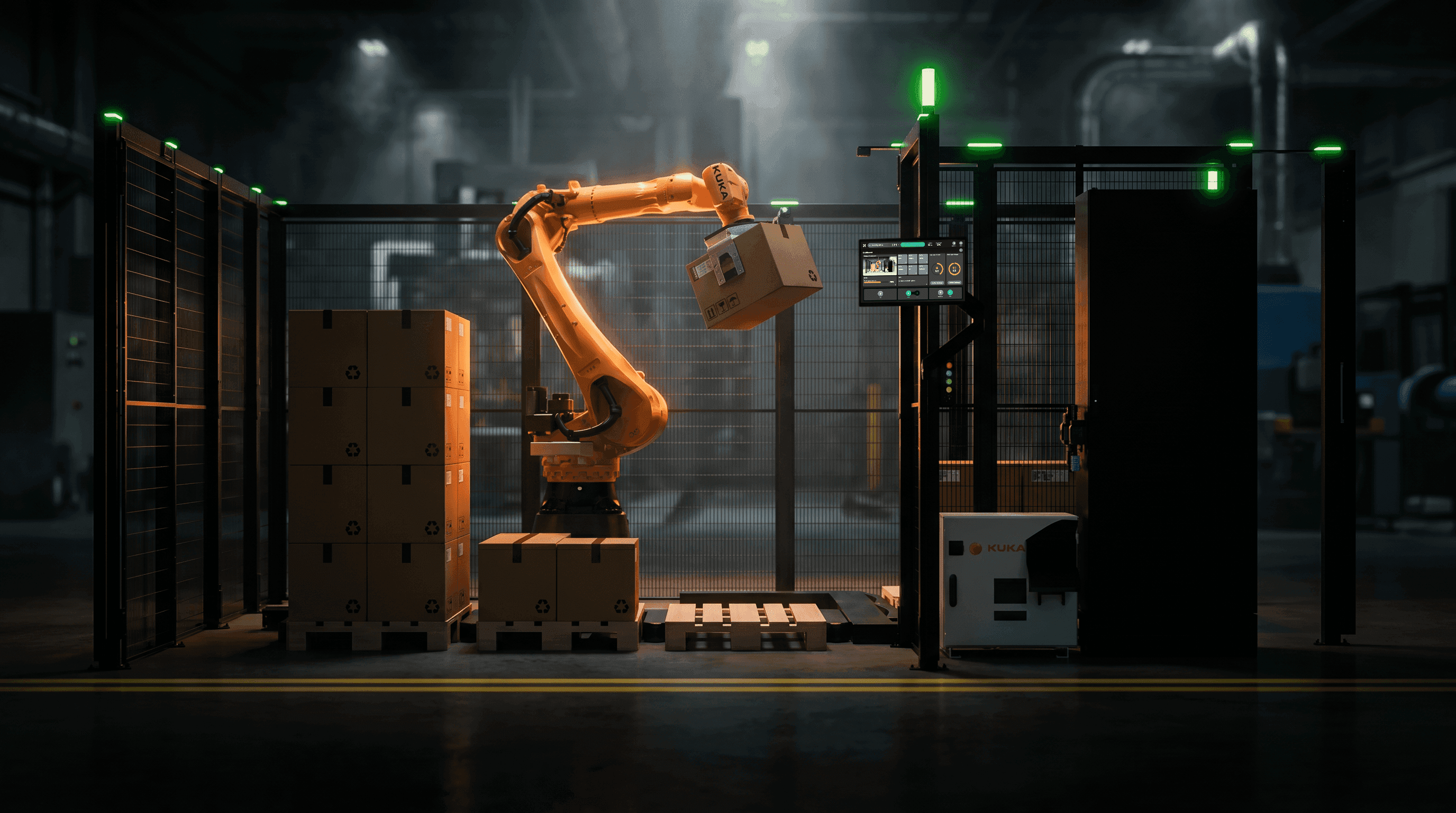

Since 2 August 2026, a realistic AI image of a real robot can fall under the EU deep fake rules. Here is how to keep robot visuals true.
Walk any automation trade fair this autumn and count the images of robot cells that were never built. Glossy cobots handing parts to smiling operators, palletisers stacking impossibly neat towers, grippers holding loads their datasheet would not survive. In my experience, more and more of that imagery is generated, not rendered from CAD.
Since 2 August 2026 that is no longer only a taste question. It is a transparency question under the EU AI Act, and for anyone selling machines to other businesses it was already a misleading-advertising question. In my work across HMI screens, 3D cell animation, trade-fair walls and marketing collateral in robotics, I see the same pattern: the risk is not that AI images look fake. The risk is that they look real and are wrong.
This post covers what the law now says, where AI visuals go wrong in robotics specifically, and a simple framework I use to decide what may be generated and what must come from engineering data.
This is a designer's reading of public legal texts, not legal advice. Check your own case with counsel.
The definition that matters: "objects"
The AI Act defines a deep fake in Article 3(60) as "AI-generated or manipulated image, audio or video content that resembles existing persons, objects, places, entities or events and would falsely appear to a person to be authentic or truthful."
Most people read "deepfake" and think of faces and politicians. The definition says objects. A photorealistic AI image of a real, named robot model doing a job it has never done looks to me like it sits uncomfortably close to that wording: it resembles an existing object, and a buyer could reasonably take it as authentic.
Article 50, which applies from 2 August 2026, attaches two sets of duties:
Providers of generative AI systems must ensure outputs are "marked in a machine-readable format and detectable as artificially generated or manipulated" (Article 50(2)).
Deployers, meaning whoever uses the AI system under its authority in a professional context (often, but not always, the company that publishes the image), must disclose when image, audio or video content generated or manipulated by the system constitutes a deep fake (Article 50(4)). For evidently artistic, creative, satirical, fictional or analogous works, the obligation is limited to disclosing that such content exists, in a way that does not hamper the work.
On 10 June 2026 the European Commission published a voluntary Code of Practice on marking and labelling AI-generated content. According to Jones Day's summary, it asks providers for "at least two layers of machine-readable marking where necessary, such as combinations of metadata, watermarks, or other technical measures," and gives deployers guidance on how to display deep fake labels, including through "the publicly available EU icon or equivalent labels."
One timing detail: according to White & Case, the AI Omnibus that entered into force in July gives systems placed on the market before 2 August 2026 until 2 December 2026 to comply with the watermarking duty. The watermarking duty sits with providers under Article 50(2), so in my reading the grace period does not touch the deployer's deep fake disclosure under Article 50(4), which applies from 2 August 2026.
The older law that bites harder: misleading advertising between businesses
The label is the easy part. The harder part is older than the AI Act.
Directive 2006/114/EC on misleading and comparative advertising exists to protect traders, which makes it the relevant text when a robotics company markets to manufacturers and integrators. Article 2(b) defines misleading advertising as advertising "which in any way, including its presentation, deceives or is likely to deceive the persons to whom it is addressed or whom it reaches" and is likely to affect their economic behaviour.
Note two words: "including its presentation." An image is presentation.
Article 3(a) lists what is assessed, starting with "the characteristics of goods or services, such as their availability, nature, execution, composition, method and date of manufacture or provision, fitness for purpose, uses, quantity, specification," and, further on, "the results to be expected from their use."
Read that list as a robotics marketer. Fitness for purpose is the application. Specification is payload, reach and repeatability. Results to be expected from use is cycle time and throughput. Those are exactly the things an AI image model invents when you prompt it for "a cobot palletising heavy boxes at high speed."
A disclosure label does not fix a wrong claim. An image that says "AI-generated" but shows a 5 kg cobot moving a 30 kg sack still tells the buyer something false about fitness for purpose.
Where AI visuals go wrong in robotics
From reviewing a lot of generated imagery against real equipment, these are the recurring errors. This list is my own experience, not a study:
Kinematics. Wrong number of axes, joints that bend in impossible directions, cable routing that would tear on the first rotation.
End-of-arm tooling. Grippers that do not exist, vacuum cups holding parts they could never seal on, fingers wrapped around objects far outside their stroke.
Payload and reach. Small arms handling large loads, or reaching across a whole line.
Safety. Operators standing inside an unguarded industrial cell, fences missing, light curtains drawn as glowing laser walls.
Brand and product identity. Colours, covers and logos that resemble a real manufacturer's robot closely enough to be mistaken for it.
Interfaces. HMI screens full of plausible but meaningless UI that suggests features the software does not have.
Every one of these would fail a review by an application engineer in under a minute. The problem is that the review often never happens, because the image arrived through marketing, not through engineering.
Provenance helps, but it does not tell the truth
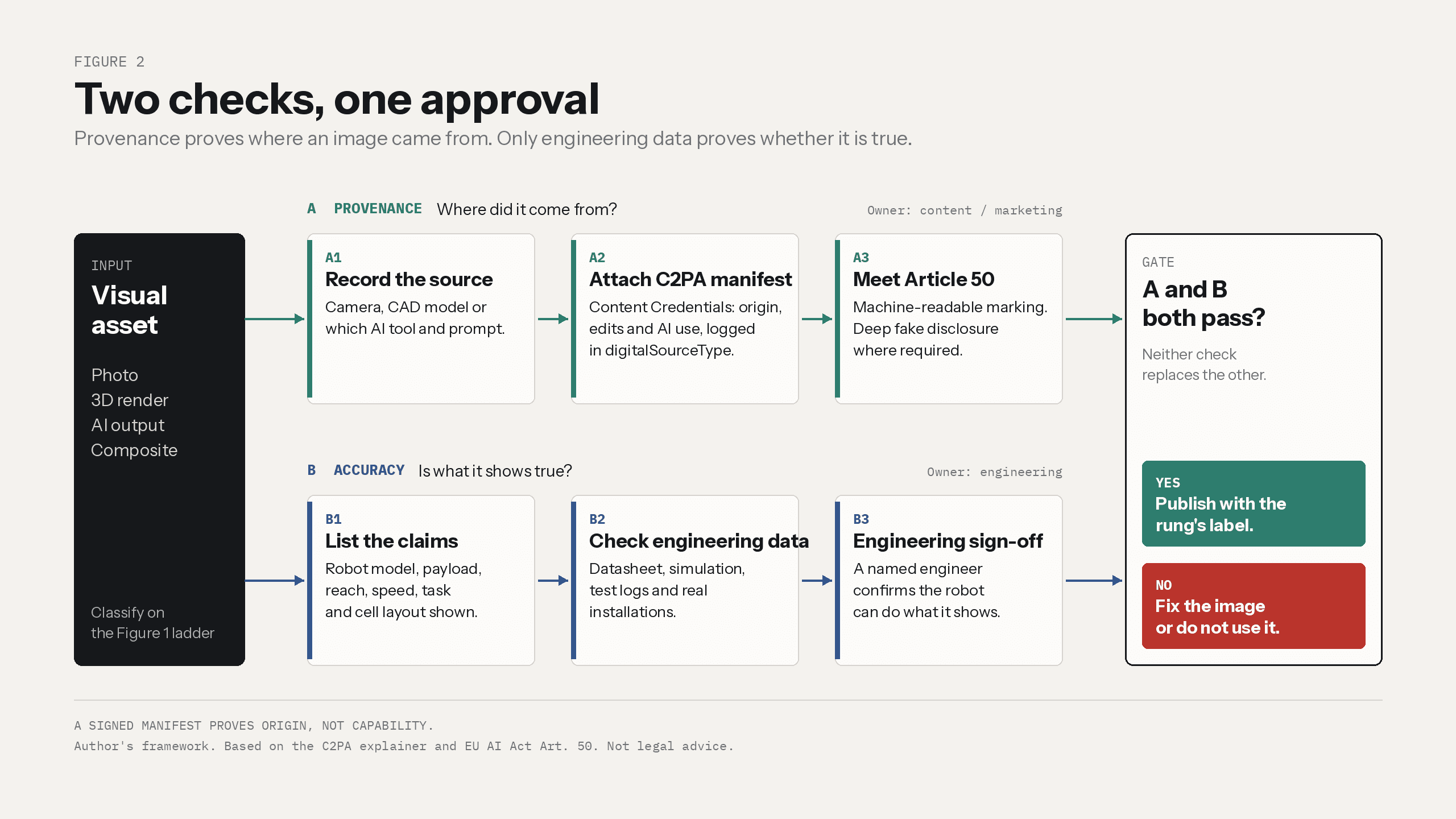
The industry answer to synthetic media is provenance. The C2PA standard, behind "Content Credentials," attaches a signed manifest to an asset. Per the C2PA explainer, that manifest holds assertions about "its origin (i.e., when and where it was created), modifications (i.e., what happened using what tools) and use of AI," and when an action was performed by an AI/ML system, it is identified as such in the manifest's digitalSourceType field.
This is useful for the Article 50 side: it gives you a machine-readable trail of what was generated. But the same explainer is explicit about the limit: "provenance information alone cannot tell you whether the digital content is true, accurate or factual."
That sentence should be printed above every robotics marketing team's desk. Provenance tells you where an image came from. Only engineering data tells you whether the robot in it can do what it shows.
The render truth ladder
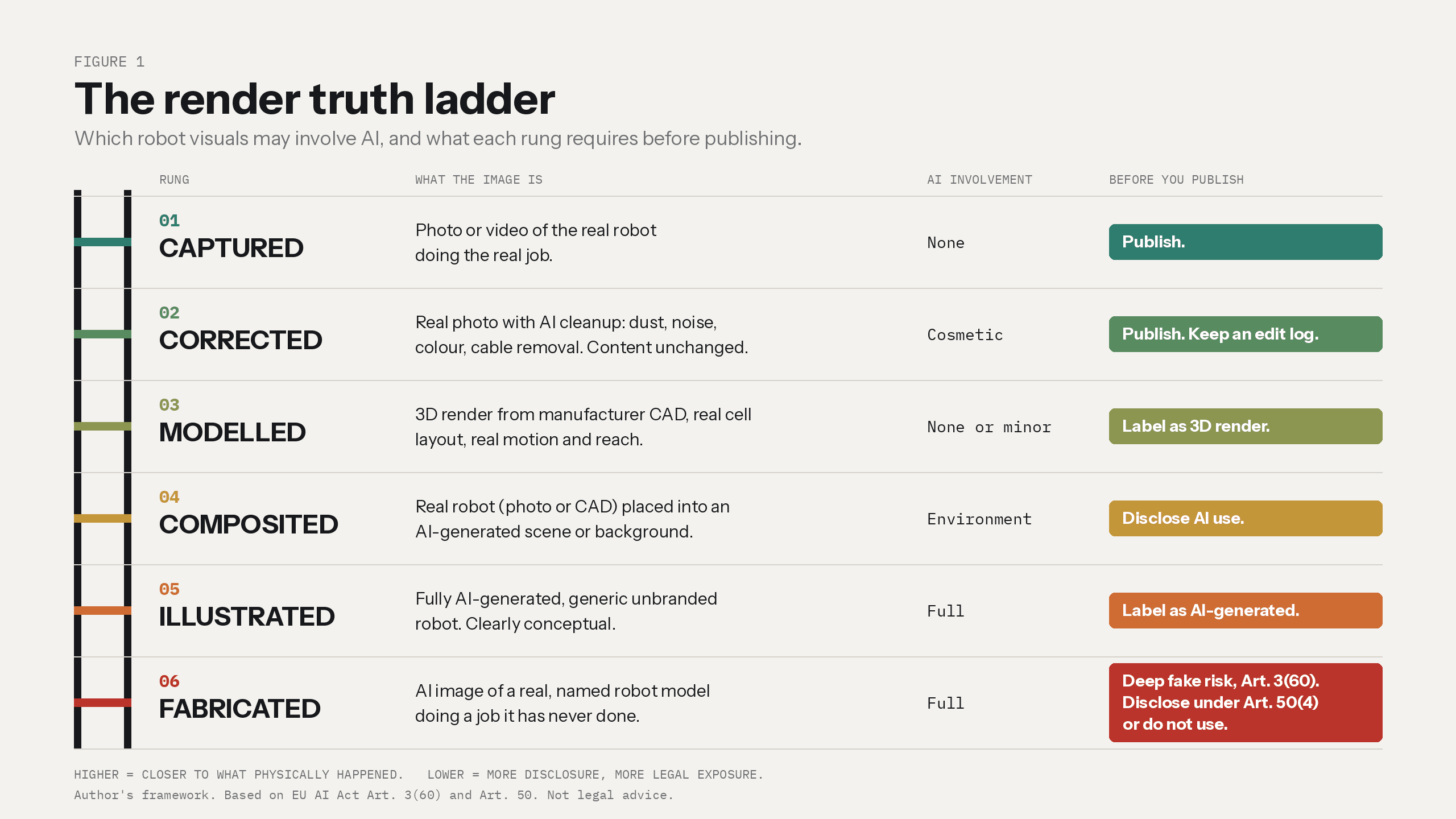
This is the framework I use. Every robot visual gets a level before it is made, not after.
Level 0: CAD-derived. Real CAD geometry, real kinematics, real tooling, real payload. Animation paths from simulation or the actual program. This is the only level allowed to carry performance claims: cycle time, payload, reach, throughput.
Level 1: CAD plus AI environment. The robot, tooling and parts are CAD and untouched. AI may generate or extend the background, lighting, factory hall or mood. The product is true; the stage is synthetic. Keep the provenance record and disclose if the scene would pass as a real installation.
Level 2: AI concept art. Fully or largely generated, clearly labelled, used for mood, editorial illustration or future-vision storytelling. No real product model identifiable, no specs, no performance claims, no customer names.
Level 3: Not allowed. AI-generated or AI-altered images of a real, identifiable product performing a task, carrying a claim, or presented as a real installation. In my framework, this is where the deep fake definition and misleading advertising overlap.
The ladder applies everywhere the brand appears: HMI splash screens and onboarding, product pages, 3D animations, trade-fair LED walls, social posts, sales decks. The LED wall matters most, because it is the largest image the buyer will ever see of your robot, and the one least likely to have been reviewed.
A practical approval checklist
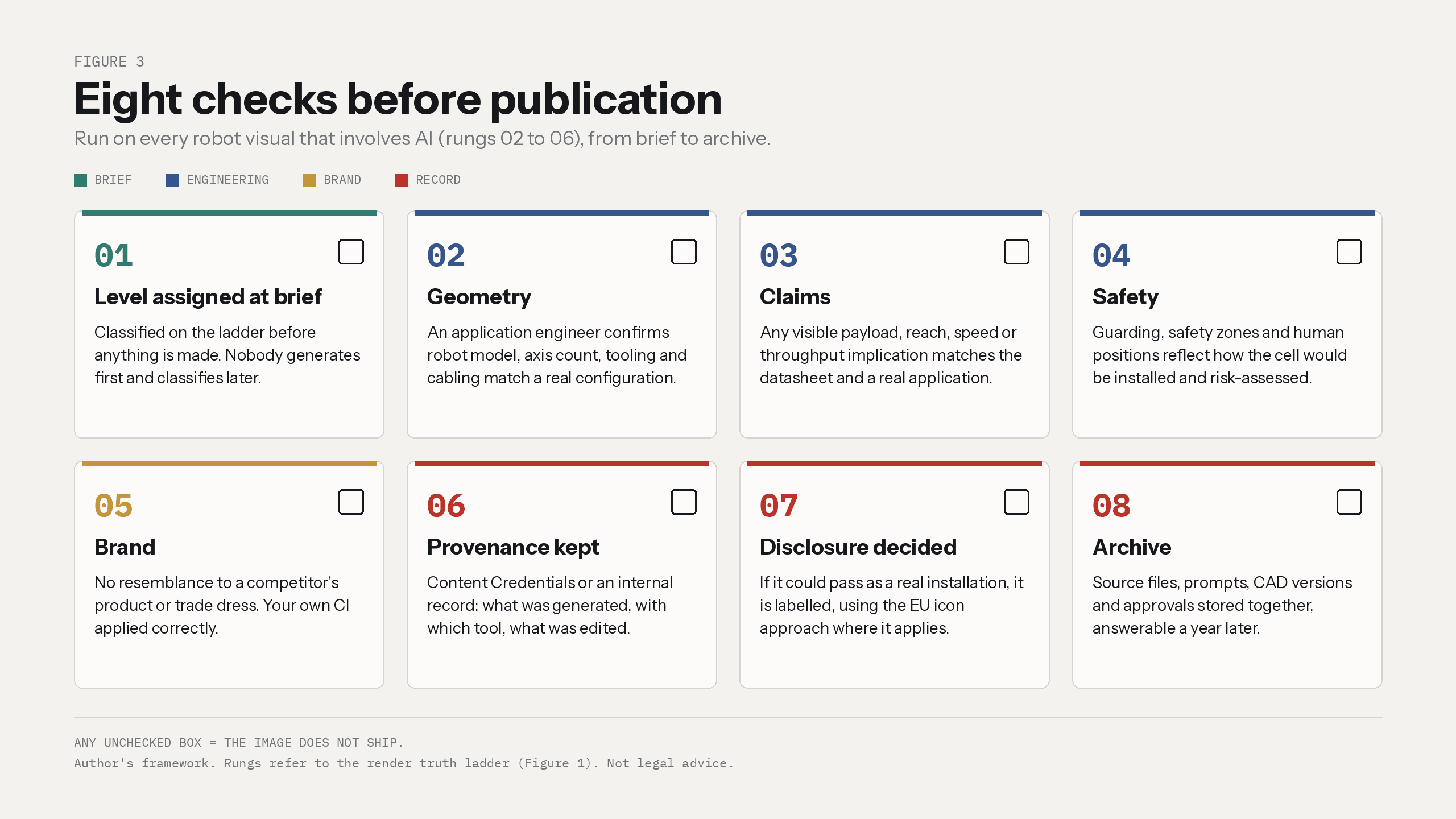
For any robot visual at Level 1 or above, I would run these checks before publication:
Level assigned at brief stage. Nobody generates first and classifies later.
Geometry check. An application engineer confirms the robot model, axis count, tooling and cabling match a real configuration.
Claim check. Any visible payload, reach, speed or throughput implication matches the datasheet and a real application.
Safety check. Guarding, safety zones and human positions reflect how the cell would actually be installed and risk-assessed.
Brand check. No resemblance to a competitor's product or trade dress; your own CI applied correctly.
Provenance kept. Content Credentials or an equivalent internal record showing what was generated, with which tool, and what was edited.
Disclosure decided. If the image could pass as a real installation, it is labelled, following the EU icon approach where it applies.
Archive. Source files, prompts, CAD versions and approvals stored together, so the question "where did this come from" has an answer a year later.
Conclusion
AI image tools are good at atmosphere and bad at engineering. That is fine, as long as each is used for what it is good at. The mistake is letting a model draw the product.
My position: in robotics, the robot itself should come from CAD, every time. Generate the hall, the light, the mood, the abstract motion on the LED wall. Keep the machine true. Buyers in this industry are engineers. They notice a wrong gripper faster than any regulator will, and the trust you lose with them does not come back with a disclosure label.
Sources
EU AI Act, Article 3 (definition 60, deep fake): https://artificialintelligenceact.eu/article/3/
EU AI Act, Article 50 (transparency obligations): https://artificialintelligenceact.eu/article/50/
European Commission, Commission publishes Code of Practice on marking and labelling AI-generated content: https://digital-strategy.ec.europa.eu/en/news/commission-publishes-code-practice-marking-and-labelling-ai-generated-content
Jones Day, European Commission publishes final Code of Practice on marking and labelling AI-generated content: https://www.jonesday.com/en/insights/2026/06/european-commission-publishes-final-code-of-practice-on-marking-and-labelling-aigenerated-content
White & Case, EU AI Omnibus enters into force, amending the AI Act: https://www.whitecase.com/insight-alert/eu-ai-omnibus-enters-force-amending-ai-act
Directive 2006/114/EC concerning misleading and comparative advertising: https://www.legislation.gov.uk/eudr/2006/114/body
C2PA, About: https://c2pa.org/about/
C2PA and Content Credentials Explainer 2.2: https://spec.c2pa.org/specifications/specifications/2.2/explainer/Explainer.html