AI-generated posts now dominate the LinkedIn feed. In robotics, the content that still earns trust is the kind that proves itself on camera.
The feed we all market into changed shape this year, and most robotics teams have not adjusted their content plan to match.
In July 2026, two independent detection companies published numbers on how much of LinkedIn is now machine-written. Pangram ran a paid browser extension from the end of April across more than a million posts from users who opted in to share data on LinkedIn, Medium, Substack, X and Reddit, and reported that 41 percent of LinkedIn long-form content, meaning posts over 250 words, was fully AI-generated, with a further 4.3 percent written with AI assistance. Originality.ai sampled 5,000 public LinkedIn posts of at least 100 words across nine topics in the same month and classified 81.2 percent of them as likely AI, up from roughly half of its sampled long-form posts in late 2024.
Those two figures are far apart, and that gap matters more than either number. AI detectors are probabilistic classifiers with different thresholds and different sampling frames, so treat both as directional rather than precise. What they agree on is the direction: a large and growing share of what scrolls past a maintenance manager on a Tuesday morning was not written by a person.
LinkedIn is not pretending otherwise. The platform added a "seems like AI slop" option to the three-dot menu on posts and comments. Chief product officer Hari Srinivasan said more than a million members had clicked it by 20 August 2026, and that content LinkedIn classifies as slop is now seeing roughly 40 percent fewer views. Asked how much of that decline came from member flags, LinkedIn's Amanda Purvis told Moneywise that the 40 percent figure is specific to the automated content classifiers LinkedIn announced on the same day as the button, not to the button itself. LinkedIn's vice president of product, Oscar Rodriguez, framed it as long-running work: "We have been working on this domain of low-quality content for a long time."
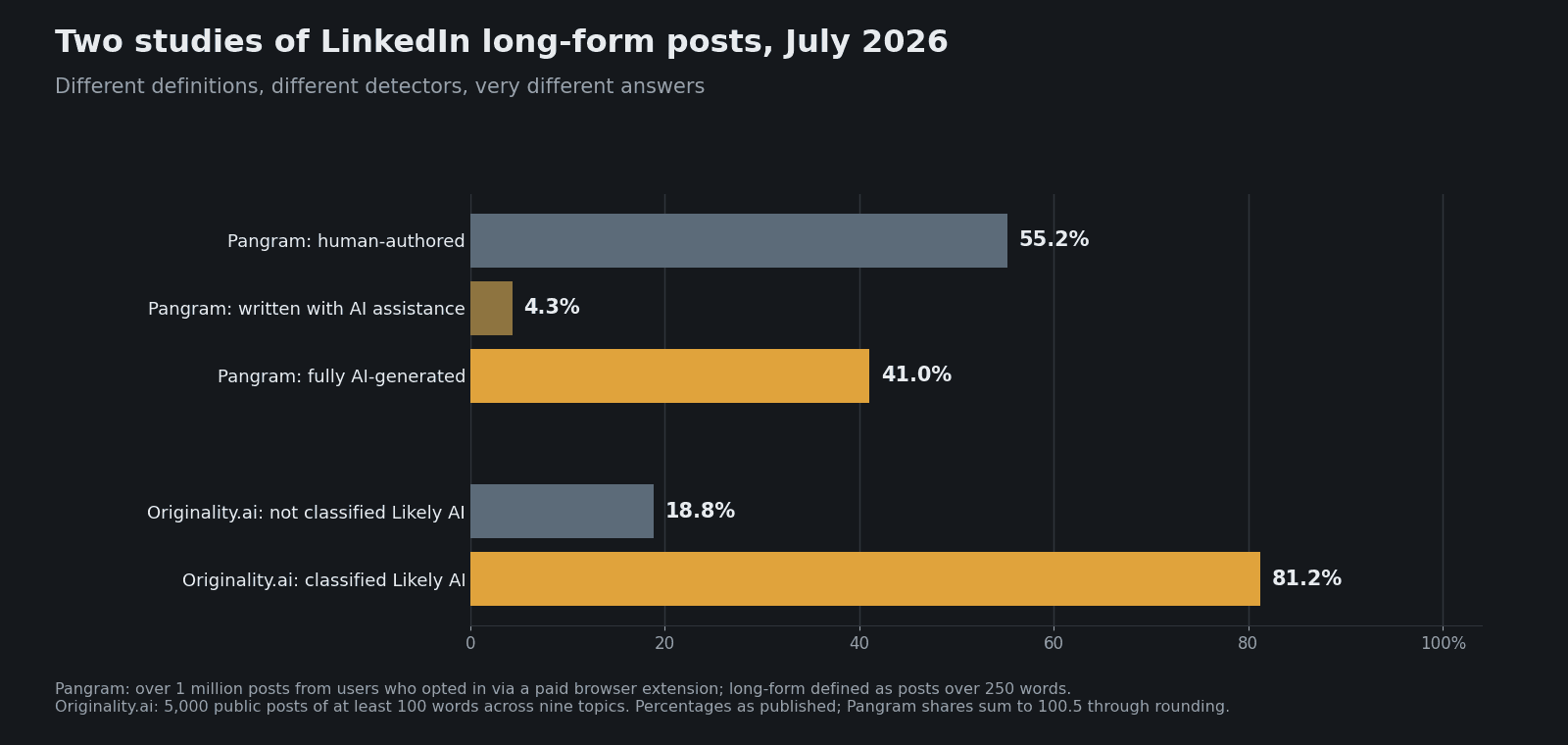
[IMAGE: fig-1.png] Two detection studies, two very different answers, one direction of travel. Sources: Pangram via The Register, 9 July 2026; Originality.ai, 30 July 2026.
So there is now a demotion mechanism pointed directly at content that reads as generated. For robotics, that is the smaller half of the problem.
Robotics carries claims that physics can check
Most B2B marketing makes claims that are hard to falsify from a video. Robotics does not. A cell video implicitly asserts a cycle time, a payload, a reach envelope, a gripper that closes on that part at that speed, a safety layout that a notified body would sign off. Every one of those is checkable by the automation engineer watching, and half of them are checkable in the first five seconds.
That audience is not hypothetical and it is not small. IFR's World Robotics 2025 report counted 542,000 industrial robots installed worldwide in 2024, against an operational stock of 4,664,000 units, up 9 percent. Europe took 16 percent of 2024 deployments with 85,000 installations, down 8 percent, and Germany installed 26,982 units, down 5 percent. In January 2026 IFR reported that the market value of industrial robot installations had reached an all-time high of 16.7 billion US dollars. A shrinking unit count in Europe alongside a record global market value describes exactly the market where buyers become more sceptical and more careful, not less.
Put a generated render of a cell into that feed and you are not risking a bland post. You are risking an engineer screenshotting your reach envelope and asking in the comments which model does 12 kilograms at that extension. There is no recovering from that with a follow-up carousel.
The penalty lands on the label, not the content
Research from the Nuremberg Institute for Market Decisions, published by Fabian Buder and Matthias Unfried in the NIM Insights research magazine, tested this directly. In one experiment, 1,000 respondents each in the USA, UK and Germany saw identical product advertisements, with half told the image was a photo and half told it was AI-generated. The labelled versions were rated as less natural and less useful, even though the content was the same pixels.
The same research found only 25 percent of participants think they can recognise AI-generated content, and only 20 percent say they trust AI itself, while 44 percent are aware that AI can create marketing content. Read those together and the strategic point is uncomfortable: your audience mostly cannot tell, mostly does not trust, and will punish you when they find out or are told. A useful nuance for our sector comes from a second experiment in the same research, run with German participants only: AI-generated advertising was more accepted for innovative, high-tech products and drew a stronger negative reaction for traditional ones. Robotics probably sits on the friendlier side of that line, which is a reason to be careful rather than a permission slip.
Disclosure is no longer only a values question
YouTube requires creators to disclose generative AI content that makes a real person appear to say or do something they did not do, alters footage of a real event or place, or generates a realistic scene that did not actually occur. Minor or aesthetic work is exempt: beauty filters, colour and lighting adjustment, cloning your own voice for a dub. A photorealistic generated shot of a cell running that never ran is squarely in the first category. YouTube states that creators who consistently choose not to disclose "may be subject to manual application of a label, or penalties from YouTube, including removal of content or suspension from the YouTube Partner Program". Labels can also be applied automatically for content made with YouTube's own tools, content carrying C2PA metadata, or content its systems detect.
That C2PA reference is the part worth watching. The Coalition for Content Provenance and Authenticity now runs a conformance program that, in its own words, "provides assurance that products adhere to the Content Credentials specification, and fulfill a set of security requirements to ensure they are producing and validating C2PA data correctly". Its Interim Trust List froze on 1 January 2026 and accepts no new entries, which pushes the ecosystem onto the formal program. LinkedIn already surfaces a "CR" label on posts carrying credentials, and clicking it reveals the creation tool, the signer, a timestamp and whether AI generated all or part of the image or video.
Do not over-invest in that plumbing yet. Reporting from 2024 on LinkedIn's rollout documented the practical holes: most people simply are not attaching credentials, the video encoders many social platforms use strip C2PA data from uploads, a creator can write fraudulent metadata before applying a valid cryptographic signature, and users are still confused about what "CR" even means. Provenance metadata is a useful second signal. It is not evidence.
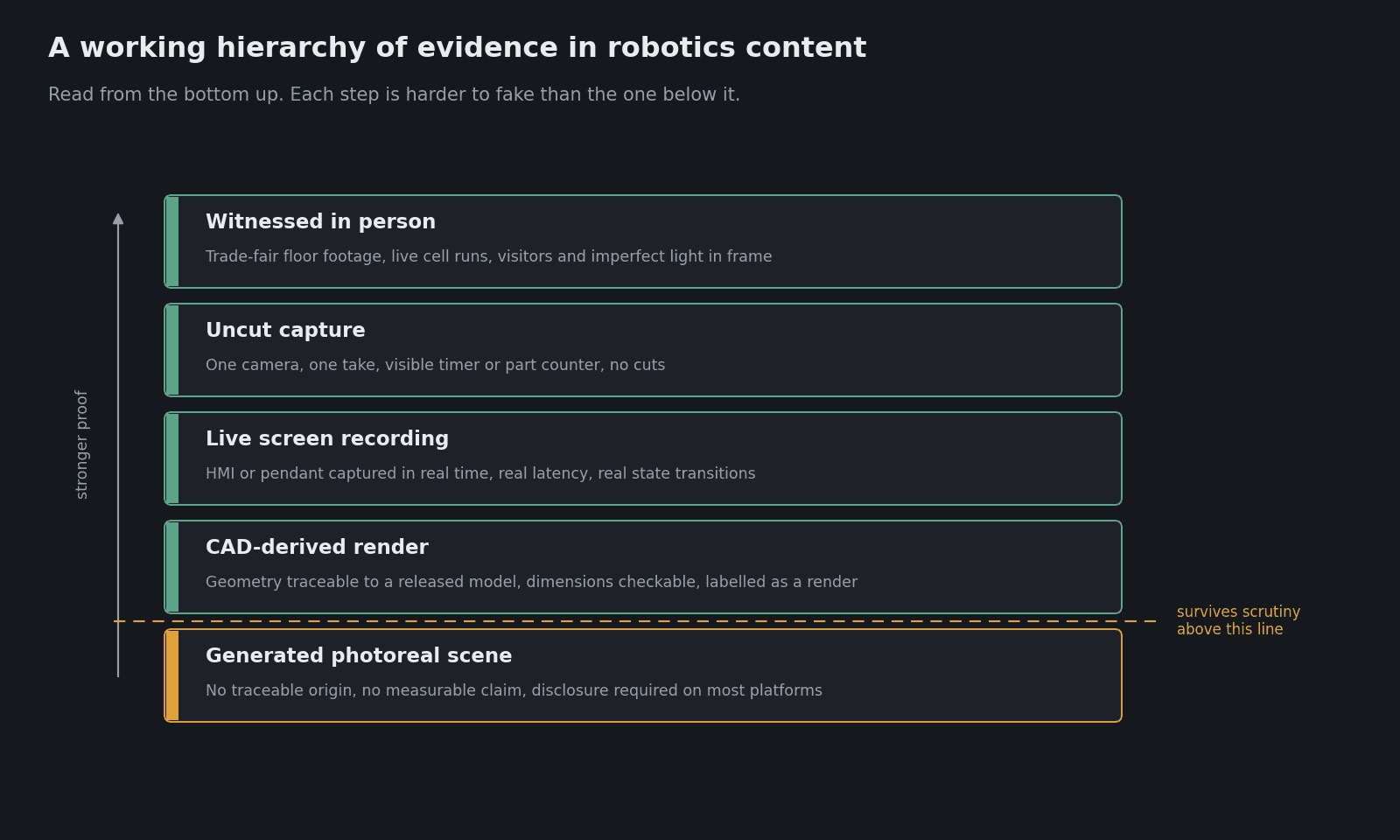
[IMAGE: fig-2.png] A working hierarchy of evidence. Everything above the line survives an engineer's scrutiny; everything below it depends on trust you have not yet earned.
Formats that carry their own proof
The formats that cut through are not the expensive ones. They are the ones that would be hard to fake and obviously costly to stage.
Uncut cycle footage with a visible clock or part counter. One camera, one take, no cuts, the timer in frame. If the cycle is 14.2 seconds, the video is 14.2 seconds plus the pick.
Failure and recovery. Show the part landing wrong and the operator clearing it. Nobody generates this, because nobody generates their own problems. It also tells an integrator more about your error handling than any spec sheet.
Screen recordings of the actual interface. Teach pendant, HMI, configuration screen, captured live with real latency and real dialogue boxes. Generated UI never gets the lag right and rarely gets the state transitions right at all.
Operator-perspective clips. Shoulder height, hands in frame, the ambient noise left in. The value is not the aesthetic, it is that the scene is clearly inhabited.
Trade-fair floor footage. People walking past, imperfect light, the stand as it actually looked on day two. Live events are one of the few remaining contexts where presence itself is the proof.
Technical carousels built from real CAD or real screenshots. Dimensioned, sourced, and dull in the way engineering documents are dull.
The takeaway: a publishing gate for robotics content
Run every asset through five questions before it goes out. If any answer is wrong, the asset does not publish.
Claim check. List every physical claim the frame makes: cycle time, payload, reach, speed, safety zone, part weight. Can each be traced to a real measurement or a real CAD file? If not, remove the claim or remove the shot.
Origin label. Tag each asset internally as captured, CAD-derived, or generated. Generated photorealistic scenes of things that did not happen are disclosed on upload, or they do not ship.
Engineer sign-off. One person who has stood in front of the actual cell approves the visual. Not the marketing lead, not the agency.
Proof artefact. Name the one element in the asset that a sceptic could verify: the on-screen timer, the uncut take, the visible part counter, the recognisable stand.
Failure rehearsal. Ask what the most hostile qualified commenter would say, and answer it inside the post rather than under it.
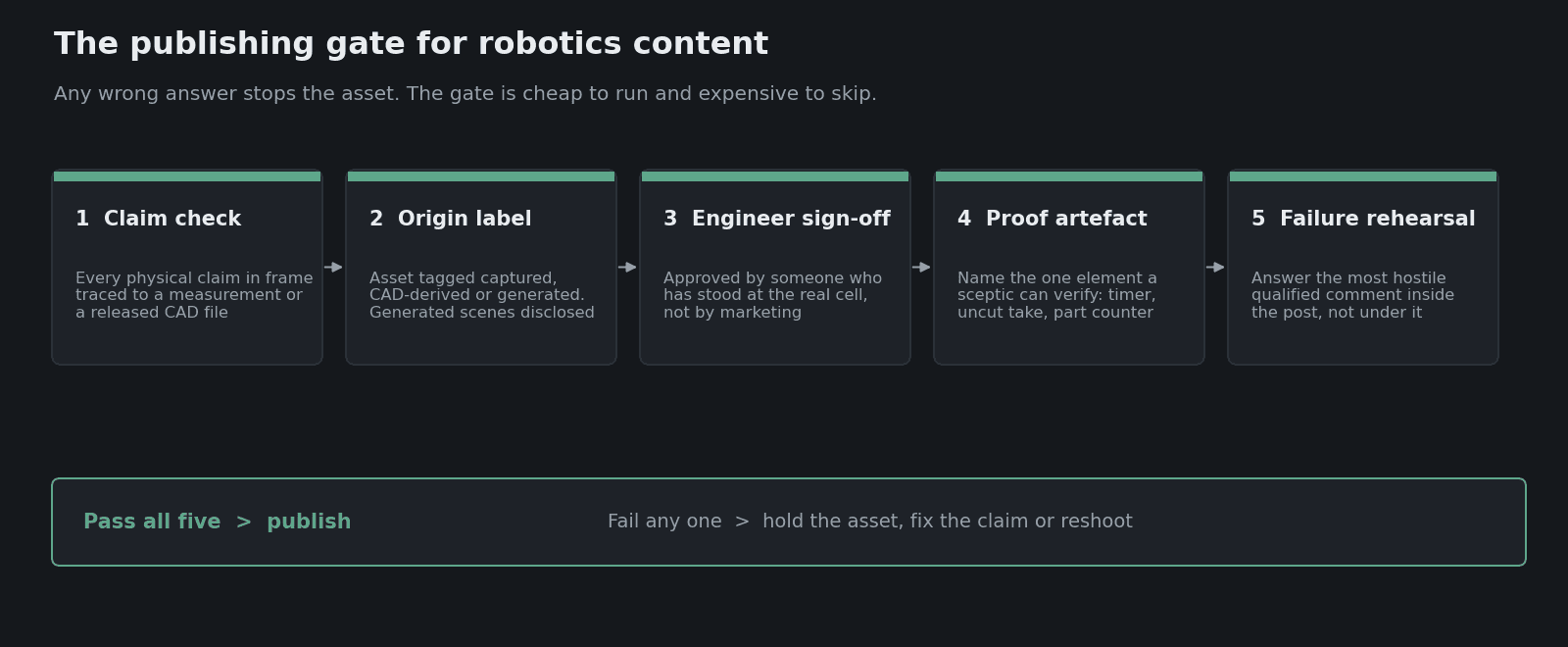
[IMAGE: fig-3.png] The gate is deliberately cheap to run and expensive to skip.
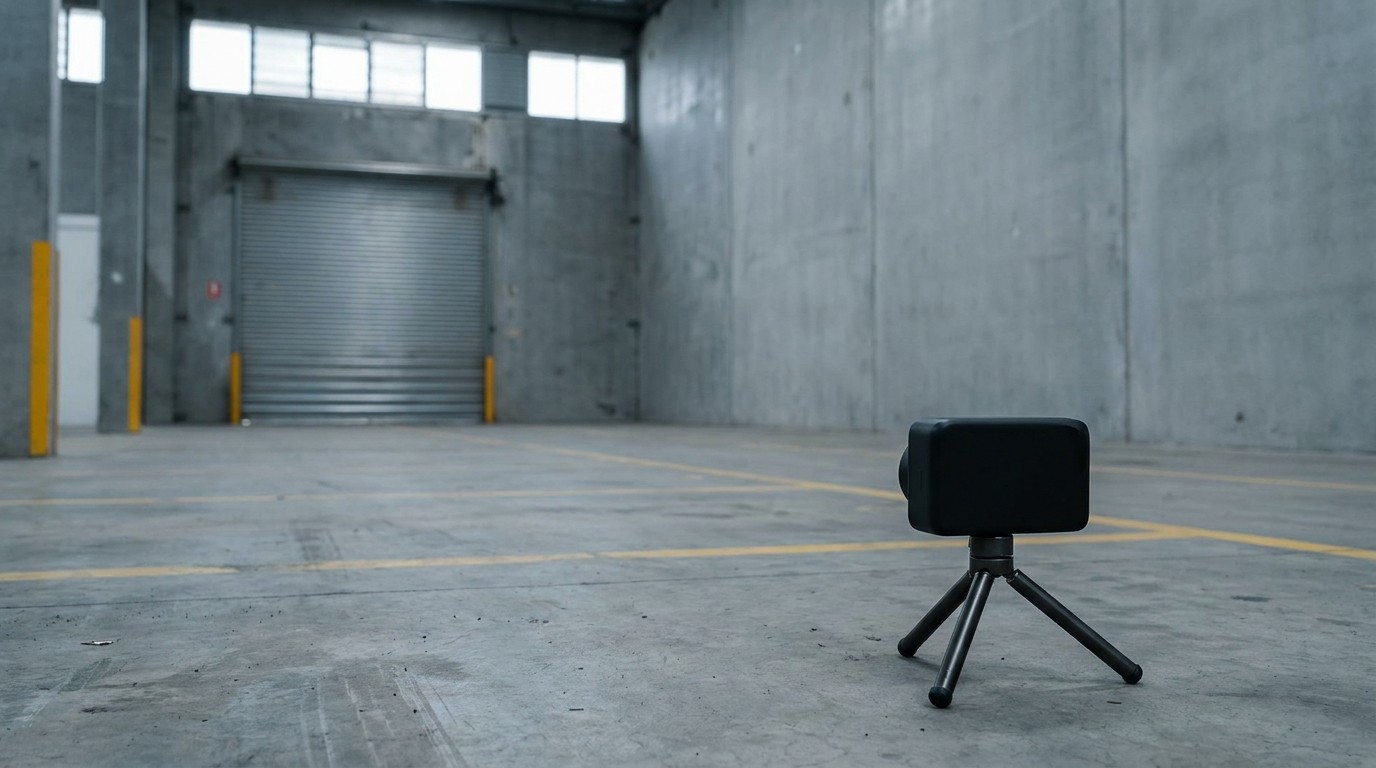
[IMAGE: fig-4.png] AI-generated illustration. The cheapest proof asset in robotics marketing is usually one camera, one take and no cuts.
Conclusion
My view is that the AI slop wave is temporarily good news for anyone doing real work in robotics. When generation is free, generated content stops being a differentiator and starts being a liability, and the cost of proof becomes the moat. A 40 percent view penalty on content a platform classifies as slop is a crude instrument, but it points the right way.
The mistake I see teams making is treating this as a disclosure problem to be managed by legal. It is a format problem to be solved by the people who build the cells. Point a phone at the machine, leave the timer in frame, publish the take where the part jams. That is not a lower production value. In this feed, it is the only production value that is scarce.
Sources
AI slop writing has taken over the internet, particularly LinkedIn and X, The Register, 9 July 2026
LinkedIn's 'Seems Like AI Slop' button drops views by 40%, Yahoo Finance / Moneywise
Tired of AI Slop on Your LinkedIn Feed? Here's How the Company Is Pushing Back, Entrepreneur
Disclosing use of altered or synthetic content, YouTube Help
LinkedIn content credentials labeling challenges, Fortune, 26 November 2024
World Robotics 2025, International Federation of Robotics, 25 September 2025
Top 5 Global Robotics Trends 2026, International Federation of Robotics, 8 January 2026