HMI UX/UI Orbiter
HMI UX/UI Orbiter
HMI UX/UI Orbiter
Built for the engineer. Configured for every robot cell imaginable.
Built for the engineer. Configured for every robot cell imaginable.
Built for the engineer. Configured for every robot cell imaginable.


HMI UX/UI Orbiter
HMI UX/UI Orbiter
HMI UX/UI Orbiter
Project Type
Project Type
Engineer-Facing Robotics HMI
Engineer-Facing Robotics HMI
Technology
Technology
Figma Design System Architecture React - Frontend Implementation Artemis API Integration Python Scripting Support Real-time Component Dashboards
Figma Design System Architecture React - Frontend Implementation Artemis API Integration Python Scripting Support Real-time Component Dashboards
Timeframe
Timeframe
Timeframe
36 Months: On-going
36 Months: On-going
36 Months: On-going
Orbiter is the engineering layer of Luna — Unchained Robotics' three tier robotics software ecosystem. A drag-and-drop interface built on modular architecture, Orbiter enables robotics engineers to configure complete robot cells to client specifications in days rather than weeks, publishing directly to Satellite for factory floor operation.
Orbiter is the engineering layer of Luna — Unchained Robotics' three tier robotics software ecosystem. A drag-and-drop interface built on modular architecture, Orbiter enables robotics engineers to configure complete robot cells to client specifications in days rather than weeks, publishing directly to Satellite for factory floor operation.
Built for the engineer. Configured for every robot cell imaginable.
Built for the engineer. Configured for every robot cell imaginable.

Brief
Design a modular drag-and-drop interface for building and publishing fully functional robot cells.
I designed Orbiter as the engineering backbone of Luna - a modular drag-and-drop interface where engineers assemble robot cells from components fed by Artemis, with every parameter set so that Satellite operators can run the system with zero technical knowledge.
Brief
Design a modular drag-and-drop interface for building and publishing fully functional robot cells.
I designed Orbiter as the engineering backbone of Luna - a modular drag-and-drop interface where engineers assemble robot cells from components fed by Artemis, with every parameter set so that Satellite operators can run the system with zero technical knowledge.
Challenge
Make engineering complexity manageable; without limiting engineering power.
The core challenge was designing an interface powerful enough for specialist robotics engineers, drag-and-drop cell assembly, Python scripting, multi-brand API integration with dashboards, and full parameter configuration, while intuitive enough to cut configuration time from weeks to days and scalable as new robot brands came online via Artemis.
Solution
Modular by design. Scalable by architecture.
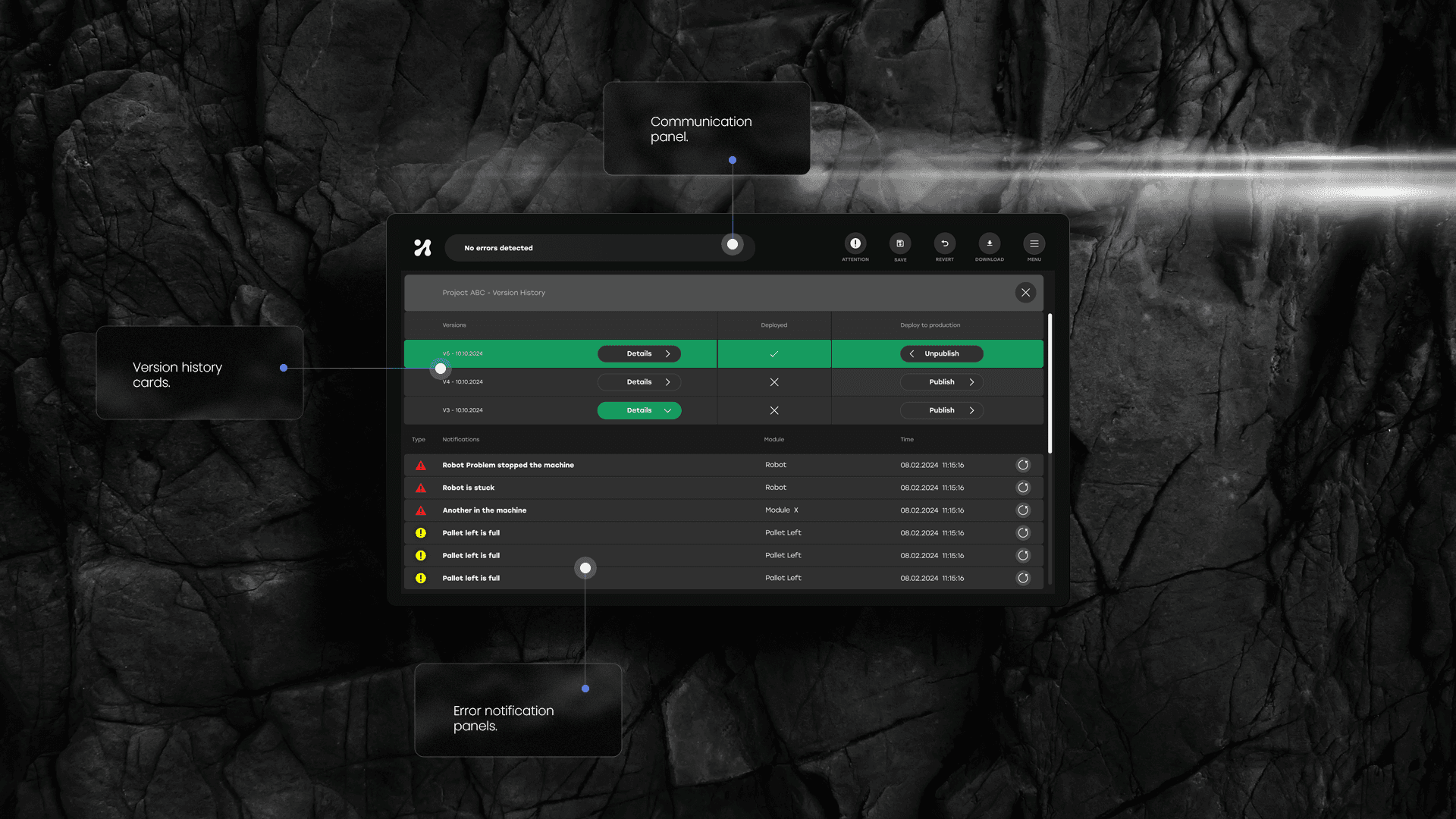
Orbiter uses a modular architecture: each component draws on Artemis, fully functional and configurable. Engineers drag and drop and customize robot cell objects via project-specific dashboards, with Python scripting for cases beyond the API. Configuration flows directly into Satellite, turning engineering work into a ready-to-use operator interface.




Results
Results
Robot cell configuration reduced from weeks to days, across any brand, any factory, any specification.
Robot cell configuration reduced from weeks to days, across any brand, any factory, any specification.
Orbiter fundamentally changed how Unchained Robotics' engineering teams configure and deploy robot cells. The modular architecture meant new components and robot brands could be brought online through Artemis without rebuilding the interface. Engineers could now configure, test, and publish complete robot cell interfaces to Satellite in a fraction of the previous time - enabling faster client delivery, reduced engineering overhead, and a scalable system built to grow with every new automation project.
Orbiter fundamentally changed how Unchained Robotics' engineering teams configure and deploy robot cells. The modular architecture meant new components and robot brands could be brought online through Artemis without rebuilding the interface. Engineers could now configure, test, and publish complete robot cell interfaces to Satellite in a fraction of the previous time - enabling faster client delivery, reduced engineering overhead, and a scalable system built to grow with every new automation project.

Credits
Built in direct collaboration with Unchained Robotics' lead engineers, lead developers, and a specialist team of robotics engineers whose deep technical expertise across multiple robot brands and automation architectures shaped every system, dashboard, and interaction in Orbiter.
Leon Potgieter
UX / UI / HMI
Leon Potgieter
UX / UI / HMI
Bashar Tomeh
Teamlead
Bashar Tomeh
Teamlead
Aakash Takkar
Robotics Engineer
Aakash Takkar
Robotics Engineer
Credits
Built in direct collaboration with Unchained Robotics' lead engineers, lead developers, and a specialist team of robotics engineers whose deep technical expertise across multiple robot brands and automation architectures shaped every system, dashboard, and interaction in Orbiter.
Leon Potgieter
UX / UI / HMI
Bashar Tomeh
Teamlead
Aakash Takkar
Robotics Engineer